
I just missed the Grand Canyon permit lottery again—year twelve—and it sent me down a rabbit hole of canyon sneaks and speed runs. One early flashpoint was Fletcher Anderson’s covert solo descent around 1977: roughly 49 hours from Lees Ferry to the Grand Wash Cliffs in a fiberglass wildwater kayak, an early fastest-known time that still reads like legend. That memory, and Kevin Fedarko’s account of The Emerald Mile, got me thinking about the canyon’s speed culture: daring, inventive, sometimes reckless. Instead of ordering these strictly by elapsed time, here’s a subjective ranking by sheer coolness.
9. John Weisheit, John Williams, and Clyde Deal — Motorized Rigid Inflatable (1993)
Speed: 35 hours, 43 minutes (motor asterisk)
In 1993 this trio pushed a 50-hp outboard on a rigid inflatable and averaged blistering speeds—about 23 mph—until Bedrock Rapid chewed up the engine. Stranded, they ran into Kenton Grua, the dory legend, who helped them jury-rig a repair. They still beat the dory record by about 55 minutes. Fast, controversial (motors get an asterisk), and memorable because Grua came to the rescue.
8. Ben Orkin and Harrison Rea — Epic 18X Sea Kayaks (January 2015)
Speed: 37 hours, 48 minutes
Newcomers to Grand Canyon speed culture, Orkin and Rea strapped ATV headlights to carbon-Kevlar sea kayaks and chased The Emerald Mile’s benchmark. They were on target until Crystal Rapid near mile 98, where Rea hit a notorious hole and cracked his hull. After repairs they finished in 37:48—the fastest kayak descent recorded to that point, and a gutsy, creative attempt.
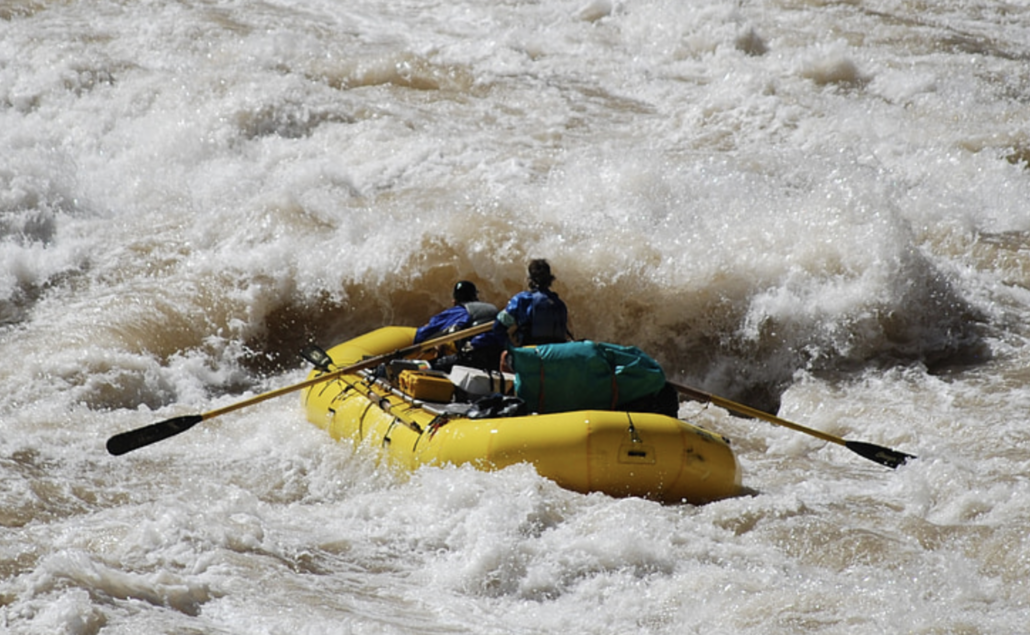
7. John Mark Seelig, Robbie Prechtl, Jeremiah Williams, Matt Norfleet, Kurt Kincel, Justin Salamon, Lyndsay Hupp, and Omar Martinez — 40-foot Seven-Oared Inflatable “Frankenstein” (January 2020)
Speed: 37 hours, 55 minutes
A follow-up to a 2017 try that failed at Lava Falls, this mostly U.S. Whitewater Rafting Team crew reworked a 40-foot cata-raft with heavy lights and sliding-seat oars. Low water (around 14,500 cfs) made the odds worse, but under a full moon they threaded Lava and posted the fastest time ever for an inflatable boat. It’s equal parts engineering, teamwork, and stubbornness.
6. Bob and Jim Rigg — Wooden Dory (1951)
Speed: 52 hours, 41 minutes
The Rigg brothers’ nonstop dory descent was the template for future speed runs. Launching into a roaring 43,100 cfs release, they rowed straight through and set an early benchmark—52 hours and change—that later crews chased and broke.
5. Walter Kirschbaum — Home-built Muslin Kayak (1960)
Speed: Unranked (about six days)
Kirschbaum pushed the boundaries of what seemed possible. After Park Service skepticism and a proving run in Cataract Canyon, he built a 14-foot muslin-and-resin kayak and paddled the Grand without portaging, completing the canyon in roughly six days. He was the first to kayak the entire Grand without portaging and did it before Glen Canyon Dam changed the river’s character.
4. Ben Orkin — Epic 18X Sea Kayak (January 2016)
Speed: 34 hours, 2 minutes (all-time record)
A year after the near-miss with Harrison Rea, Orkin returned solo and went for it. With a group having just set a new time of 35 hours, he blasted off and chased a brutal pace. He flipped at Lava Falls, missed a roll, and banged himself on a rock, losing nearly an hour while recovering. Still, he made up time and finished Lees Ferry to Grand Wash Cliffs in an astonishing 34:02—the fastest known descent.
3. Fletcher Anderson — Fiberglass Wildwater Racing Kayak (circa 1977)
Speed: about 49 hours
Published anonymously as “The Big Sneak,” the tale of a clandestine solo run through the canyon revealed itself years later as Fletcher Anderson’s exploit. Paddling a fiberglass racing kayak, he broke the solo mark and endured severe fatigue and hallucinations. The under-the-radar nature and the raw personal survival story make this an enduring early classic.
2. Kenton Grua, Rudi Petschek, and Steve Reynolds — Wooden Dory, The Emerald Mile (1983)
Speed: 36 hours, 38 minutes
When Glen Canyon Dam released an extraordinary flood—roughly 72,000 cfs—these three rebuilt a wooden dory and rode the surge. They rowed day and night, surviving terrifying hydraulics: Crystal Rapid nearly cartwheeled them, they were scattered in a churning eddy, and they righted and continued. Their 36:38 run became the mythic standard and inspired a generation to chase river speed.
1. Team Beer — Matt Klema, Nate Klema, Ben Luck, and Ryan Casey — Plastic Downriver Kayaks (January 2016)
Speed: Matt Klema first in 35 hours, 5 minutes
Team Beer pulled a permit, borrowed plastic kayaks (three Pyranha Speeders and a Perception Wavehopper), and showed that good gear, grit, and humor can topple myths. Fueled by river water and a three-pound bucket of fried chicken, all four beat The Emerald Mile’s time; Matt Klema crossed first in 35:05. Their run was smooth, roll-free, and sportsmanlike—what really sticks is how they celebrated the shared achievement and even emailed Ben Orkin to let him know there was a time to chase.
Notes: Motorized craft are marked with an asterisk. This list is selective, not exhaustive. Other notable runs include a just-under-48-hour dory run by Grua, Petschek, and Wally Rist in 1980 and a USA rafting team time of 37:24 in 2017.