Quick take: Hawaiian’s 787‑9 Dreamliner offers a lively, island‑inspired transpacific business class with private suites, tasty food, and decent award availability. It’s a great choice when routes match your plans, though the drinks program and onboard connectivity could improve.
Pros
– Private suites with closing doors and colorful finishes
– Creative, flavorful menus
– Good Saver award availability on operated routes
Cons
– Beverage program is solid but not ultra‑premium
– Limited mainland–Asia frequency
– No functional onboard Wi‑Fi on my flight
Overview
Hawaiian began receiving 787‑9s two years ago and now flies five. With Alaska’s acquisition underway, the Dreamliners are already on longer transpacific runs such as Seattle–Tokyo Narita and Seattle–Seoul Incheon, and will expand to other long‑haul routes. I tested the product on an award ticket from Tokyo to Seattle booked with Alaska Atmos Rewards.
Booking and value
Cash fares depend on route and date; my one‑way Tokyo–Seattle fare was $3,320. I redeemed 95,000 Alaska Atmos Rewards points plus $54 in taxes and fees, about 3.4¢ per point. Qantas redemptions are another option (about 90,000 Qantas miles plus higher fees). Alaska transfers include 1:1 partnerships with Bilt and 3:1 from Marriott Bonvoy, and Atmos cobranded cards are the fastest points path.
Airport experience
Hawaiian operates out of Terminal 2 at Narita, with convenient Skyliner access. Business passengers get priority check‑in, two generous checked bags (up to 32 kg/70 lb each), lounge access (I used the Japan Airlines Sakura Lounge), TSA PreCheck participation, and priority boarding. Expect normal security and immigration waits at NRT; plan to arrive early. Boarding was generally timely.
Cabin and seats
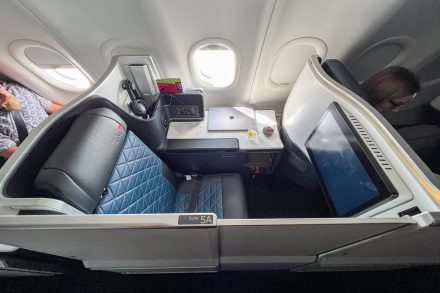
The cabin palette, called leihoku or ‘garland of stars,’ leans into island colors and textures. Key specs:
– 34 business seats in a 1‑2‑1 layout
– Fully flat length: 77 inches
– Seat width: 21 inches (about 26 inches with armrest lowered)
– 18‑inch touchscreen
Hawaiian fits Adient Aerospace Ascent suites with closing privacy doors. Window seats face outward; center pairs angle toward the aisle and have close back‑to‑back seating for companions, while solo travelers get large privacy dividers. After takeoff the doors lock and the seat shell rises to roughly 44 inches with an ~11‑inch gap at the bottom.
Controls include three preset positions, independent legrest adjustment, and a do‑not‑disturb light. The dining table slides out from beneath the monitor and swings into place. Power options include universal AC and USB‑A ports (no USB‑C in business) plus a vertical wireless phone charger built into the seatback; I charged an iPhone 15 fully overnight using the pad. Storage is limited to an armrest compartment, the phone pad, and a small cubby suitable for headphones or a toiletry pouch. The foot cubby is about 12 inches high and 16 inches wide at its widest, which may feel tight for some.
Comfort notes
Seats were comfortable in both lounge and lie‑flat modes. Noho Home bedding (pillow, seat cover and a lightweight duvet) makes sleeping straightforward. Business class lacks individual overhead air nozzles, but the cabin was kept cool by the crew. Two lavatories for 34 passengers led to short lines during meal service and before landing; they were clean and stocked with Loli’i skincare products.
Amenities and entertainment
On boarding I found slippers and bedding. Instead of full preset kits, attendants handed small pouches and later offered items from a selection to minimize waste — eye masks, socks, earplugs, sprays and lip balm. No pajamas were provided. Starlink Wi‑Fi was not functional on my flight.
Entertainment runs on an 18‑inch touchscreen with recent movies, TV shows, music and a moving map; a wired remote is embedded in the seat shell. Provided headphones are adequate but not high‑end noise‑canceling units.
Service and predeparture
Boarding through the second door let the crew circulate with menus and predeparture drinks such as Prosecco, Hawaiian mai tais, guava juice and water. Flight attendants took meal and drink orders before pushback and served macadamia nuts with drinks.
Dining
There are three dinner menus: Japanese, vegetarian and Hawaiian fusion. Preordering is available but on some flights preorders didn’t exactly match the onboard offerings.
Highlights I sampled:
– Japanese option: multi‑item appetizers, grilled flounder with yuan sauce, rice, miso and pickles.
– Vegetarian: rolled eggplant with ricotta, asparagus salad, hot‑and‑sour soup and bread.
– Hawaiian fusion: hot‑and‑sour noodle soup and vegetable starter, asparagus salad with hearts of palm, and a braised boneless short rib with scallion‑ginger risotto — tender and well seasoned. Dessert choices included a light mango chiboust cake or a cheese plate; the mango cake was a pleasing finish.
Breakfast, served about 90 minutes before landing, offered a roasted bell pepper and kale tamagoyaki omelet with chicken sausage or sweet bread French toast with lilikoi syrup. I had the omelet, accompanied by warm croissants and fresh fruit.
Wines and drinks
The beverage list is wide but not ultra‑luxury. Selections included Lanson Pere et Fils NV champagne, a Flor prosecco, 21 Degrees chardonnay and cabernet, Benvolio pinot grigio, La Mozza sangiovese and HeavenSake Junmai Ginjo. Signature cocktails were Ko Hana mai tai and lilikoi daiquiri, plus an On the Rocks Old Fashioned. Local beers and spirits such as Maui beer and Kōloa rum round out the choices. Cocktails were enjoyable but not standout.
Operational notes
– Saver award availability is relatively good on Hawaiian’s Dreamliner routes.
– Limited U.S. mainland to Asia frequency reduces flexibility.
– Starlink Wi‑Fi was not active on my flight; expect rollouts to improve connectivity.
– Some guests reported occasional mismatches between preordered meals and what was served.
Verdict
Hawaiian’s 787 business class is a distinctive and enjoyable transpacific option. Private suites with doors, island‑inspired décor, wireless charging and attentive meal service differentiate it from many competitors. If Hawaiian expands routes and finalizes Starlink, the product will be even more compelling. For now, it’s a strong choice when schedules and routes align, especially if you can take advantage of award availability.