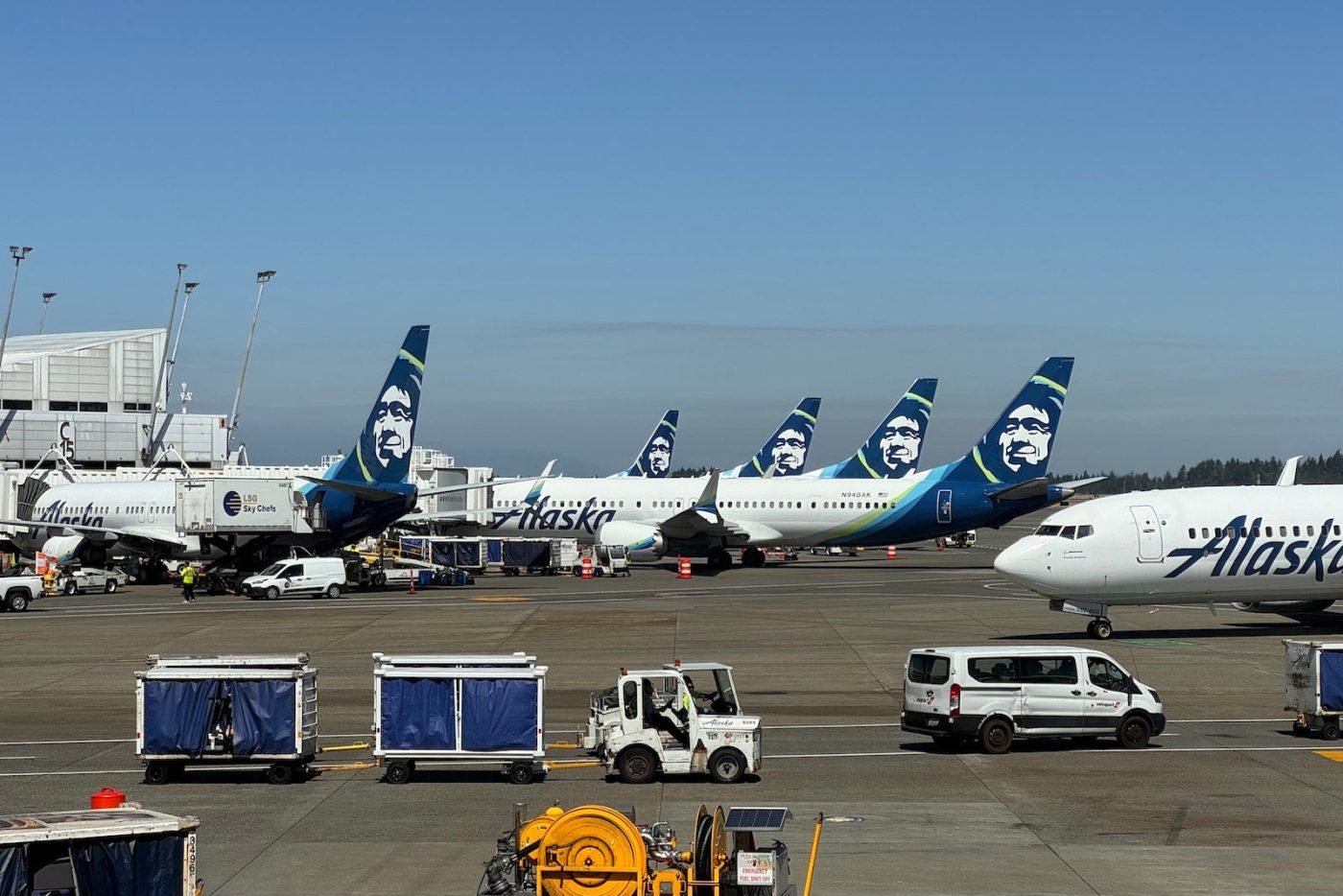

Alaska Airlines is in the middle of a strategic shift from a West Coast carrier to a more national and global airline. Since acquiring Hawaiian Airlines just over a year ago, Alaska has rolled out a combined Atmos Rewards loyalty program, launched a premium cobranded credit card, begun Asia service from Seattle-Tacoma (SEA) and integrated large portions of its operations with Hawaiian’s.
New long-haul routes and aircraft are set to arrive in 2026: nonstop flights to London, Rome and Iceland will launch, and Alaska will start flying twin-aisle Boeing 787 Dreamliners repainted in a new global livery.
Why Portland and San Diego?
Alaska recently added 13 new routes and trimmed seven in other West Coast markets, signaling a clear investment in Portland (PDX) and San Diego (SAN). Cirium data projects departures from SAN will increase roughly 50% in early 2026 versus 2025, while departures from PDX are expected to rise about 14%.
Portland is being built up as a true connecting hub. Alaska’s network planners say PDX now supports many more useful one-stop itineraries, creating connect-the-dots options that expand the carrier’s overall route map. San Diego’s expansion is driven in part by loyalty engagement: strong Atmos Rewards enrollment and high returns on cobranded credit-card signups in the market demonstrate local brand strength and justify adding capacity. In both cities, Alaska says demand has reacted positively to the additional service.
Not just a West Coast carrier
Alaska increasingly markets itself beyond the Pacific Coast. The combined Alaska–Hawaiian network enables single-connection travel from U.S. cities east of the Rockies — such as Raleigh, Tampa and Pittsburgh — to destinations in Japan and South Korea on Alaska-operated itineraries. Favorable award pricing and redemptions on partner carriers, plus Atmos Rewards, have helped attract travelers who might not previously have considered Alaska, boosting the airline’s national relevance.
Competition at SEA and reclaiming customers
Alaska’s international expansion has intensified competition at SEA, particularly with Delta Air Lines. After Alaska announced Rome service, Delta announced its own European expansion from Seattle, including Rome. Alaska views this back-and-forth as a competitive opportunity to win back customers who historically preferred carriers with long-haul offerings.
Hawaiian integration and brand strategy
Hawaiian Airlines remains a distinct brand within Alaska Air Group, but operational and fleet integration is underway. Hawaiian’s Boeing 787 Dreamliners — existing and incoming — will enter service in 2026 with Alaska’s new global livery. Hawaiian currently operates several Asia routes from Seattle; those flights will gradually transition to Alaska branding over time.
Hawaiian’s Airbus A330s will continue on longer-haul routes and are slated for cabin upgrades, including the addition of premium-economy cabins. Alaska Air Group expects most flying to and from Hawaii to remain under the Hawaiian brand and livery, while it evaluates which subfleets make sense to repaint or operate under Alaska markings.
Using Honolulu as a connector
Rather than immediately launching new long-haul Hawaiian-branded routes, the near-term focus is network integration that lets passengers use Daniel K. Inouye International Airport (HNL) as a connecting gateway to Australia, New Zealand and parts of Asia. Alaska argues that routing through Honolulu can be more direct for some transpacific itineraries than routing through mainland West Coast hubs like Los Angeles.
Outlook
Alaska’s strategy combines loyalty growth, targeted hub investment and fleet-branding moves tied to the Hawaiian merger. Expanding PDX as a connecting hub and scaling SAN to capture revenue from loyalty and credit-card activity are central to near-term growth. Broader international ambitions — new nonstop routes, Dreamliners in a global livery and integrated Alaska–Hawaiian operations — aim to make Alaska a more nationally and globally relevant carrier. Competition at Seattle will likely remain intense as Delta and others respond, but Alaska expects its expanded international footprint and the Hawaiian tie-up to help it regain market share.